Readable article text is presented below, with the supplied magazine scans available here for reference to the original layout, photographs, captions, and typography.
Original magazine scans
Readable article text
A Rising Star
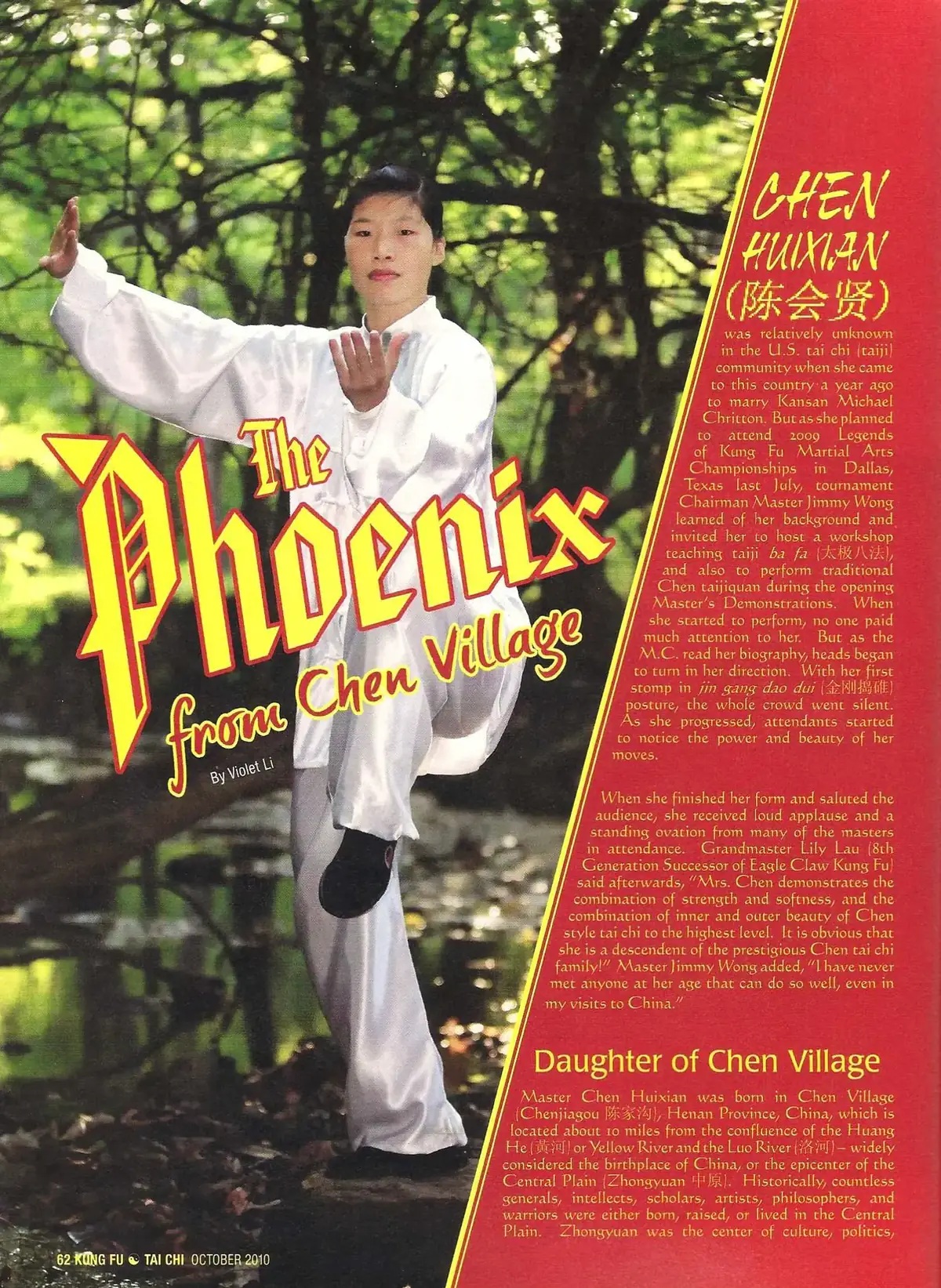
Chen Huixian (http://www.chenhuixian.org/instructors.aspx) is relatively unknown in the U.S. Tai Chi (Taiji) community. She came to this country about a year ago to marry Kansan Michael Chritton. Last July she was planning to attend 2009 Legends of Kung Fu Martial Arts Championships in Dallas, Texas. Once tournament Chairman Master Jimmy Wong learned her background, he invited her to host a workshop teaching Taiji Ba Fa (太极八法). They also asked her to do a performance of traditional Chen Taijiquan during the opening Master's Demonstrations. When she started to perform, no one paid much attention to her. But as the M.C. read her biography, heads began to turn her direction. With the first stomp of her foot in the Jin Gang Dao Dui (金刚捣碓) posture, the whole crowd went silent. As she progressed, attendants started to notice how powerful yet beautiful her moves were. When she finished her form and saluted the audience, she received loud applause and a standing ovation from many of the masters in attendance. Grandmaster Lily Lau (http://www.lilylaueagleclaw.com), 8th Generation Successor of Eagle Claw Kung Fu, said afterwards, “Mrs. Chen demonstrates the combination of strength and softness, and the combination of inner and outer beauty of Chen style Tai Chi to the highest level. It is obvious that she is a descendent of the prestigious Chen Tai Chi family!" And Master Jimmy Wong (http://www.jkwongkungfutaichi.com/profiles.htm) commented, “I have never met anyone at her age that can do so well, even in my visits to China.”
Daughter of Chen Village
Master Chen Huixian is unique. She was born in Chen Village (Chenjiagou陈家沟), Henan Province, China. Chenjiagou is located about 10 miles from the confluence of the Huang He (黃河) or Yellow River and the Luo River (洛河) which is also considered to be the birth place of China, or the epicenter of the Central Plain (Zhongyuan 中原). Historically, countless generals, intellects, scholars, artists, philosophers, and warriors were either born, raised, or lived in the Central Plain. Zhongyuan was the center of culture, politics, literature, agriculture, medicine, economy, arts, and creativity of all forms, including martial arts. It is no wonder that Chenjiagou gave birth to such a profound piece of Chinese culture and heritage: Taijiquan. Master Chen Huixian's father, Grandmaster Chen Chunlei, always stood out in a crowd (he was well over 6-foot tall and built more like an NFL lineman than a Tai Chi Master). So does his daughter. For most of her life she has been as large (if not larger) than most of the boys in the Chen Village. Growing up, she was considered a tomboy who admired Wushu tremendously as a child. She started to take traditional Chen Style Taijiquan lessons from her father Grandmaster Chen Chunlei at the age of six. Her father would make her spar and wrestle with her Chen-family cousins (her older, boy cousins - and usually two at a time two keep it fair.) Her desire of learning and mastering the art grew. At the age of seventeen, she began to study Tai Chi with her uncle, Grandmaster Chen
Zhenglei, the 19th generation of Chen's family, the 11th generation direct-line successor of Chen Family Taijiquan (Tai Chi Chuan), and one of the “Top Ten Martial Arts Masters” in China. It was not long before she became his official disciple.
One of the first and most valuable lessons her uncle taught her was that even being born with the natural talent of the Chen Family Bloodline, one must still work very hard to achieve higher skill in Taijiquan. So in 1998, she began intense study with her uncle's senior disciple, Wang Haijun. For two years, Chen Huixian trained 6 to 8 hours every day, 6 days-a-week at Wang Haijun's school in Zhengzhou City, studying numerous different Taijiquan training methods. When Wang Haijun left Zhengzhou to open a new school in Manchester, U.K., Chen Huixian took the opportunity to go back home to Chenjiagou. But once in Chenjiagou, she could not sit still and continued with her strict training regimen. This time, she returned to the Chen Village Taijiquan Training Center, owned and operated by one of her other uncles, Grandmaster Chen Xiaoxing. For six months, she studied Push-Hands with her cousin, Chen Ziqiang and others. She would like to have stayed much longer, but she was asked to take a position as the Head Taijiquan Instructor at the Deng Feng All Girls Wushu (Martial Arts) School, as well as serving as the Senior Tai Chi Advisor to the Shaolin Temple's International Demonstration Team. After a year in at the Shaolin Temple, Grandmaster Chen Zhenglei asked her to return to Zhengzhou City. This time she was hired as a coach for his ‘Chen Village Tai Chi Training Center’, where she remained until she left for college in 2003. While studying at National Tianjin Normal University, she was again employed by her uncle's Tai Chi Training Center in Tianjin as she finished her degree in Physical Education. Teaching Chen Tai Chi full time while studying Phys. Ed. gave her an even deeper insight into not only the physical requirements and health benefits of Tai Chi, but it also helped her develop methods of training students more effectively and efficiently. Throughout her short career, Master Chen has won numerous competitions in the categories of Tai Chi Form, Tai Chi Weapons, and Push-Hands at regional, national and international levels.
Spreading the Village Tradition in the U.S.
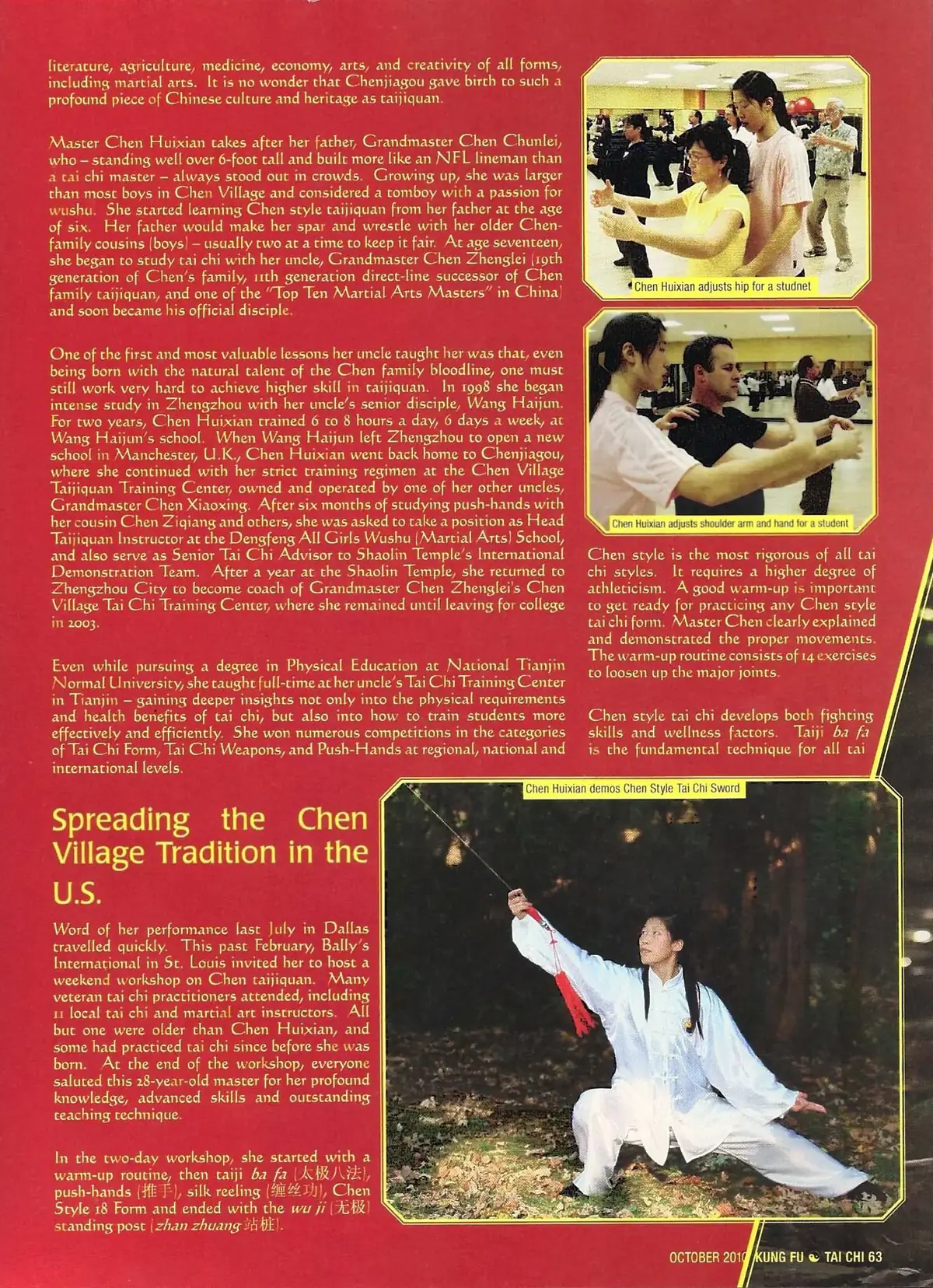
Word of her performance in Dallas last July travelled quickly. In late February this year, she was invited by Bally's International in St. Louis to host a weekend workshop on Chen Taijiquan. There were many veteran Tai Chi practitioners, including 11 local Tai Chi and martial art instructors. With but one exception, every student was older than her, and some had practiced Tai Chi since before she was born. With her profound knowledge and advanced skills, at the end of the workshop, everyone saluted to this 28- year-old Master with respect. Her workshop in St. Louis demonstrated her deep knowledge of Tai Chi as well as her outstanding teaching skills. In the two-day workshop, she started with a warm-up routine, then Taiji BaFa (太极八法), Push-hands (推手), Silk Reeling (缠丝功), Chen Style 18 Form and ended with the Wu Ji (无极) Standing Post (Zhan Zhuang站桩).
Compared with other Tai Chi Styles, Chen Style is the most rigorous one. It requires a higher degree of athleticism. A good warm-up is important to get ready for practicing any Chen Style Tai Chi form. Master Chen clearly explained and demonstrated the proper movements. The warm-up routine consists of 14 exercises to loosen up the major joints of a body.
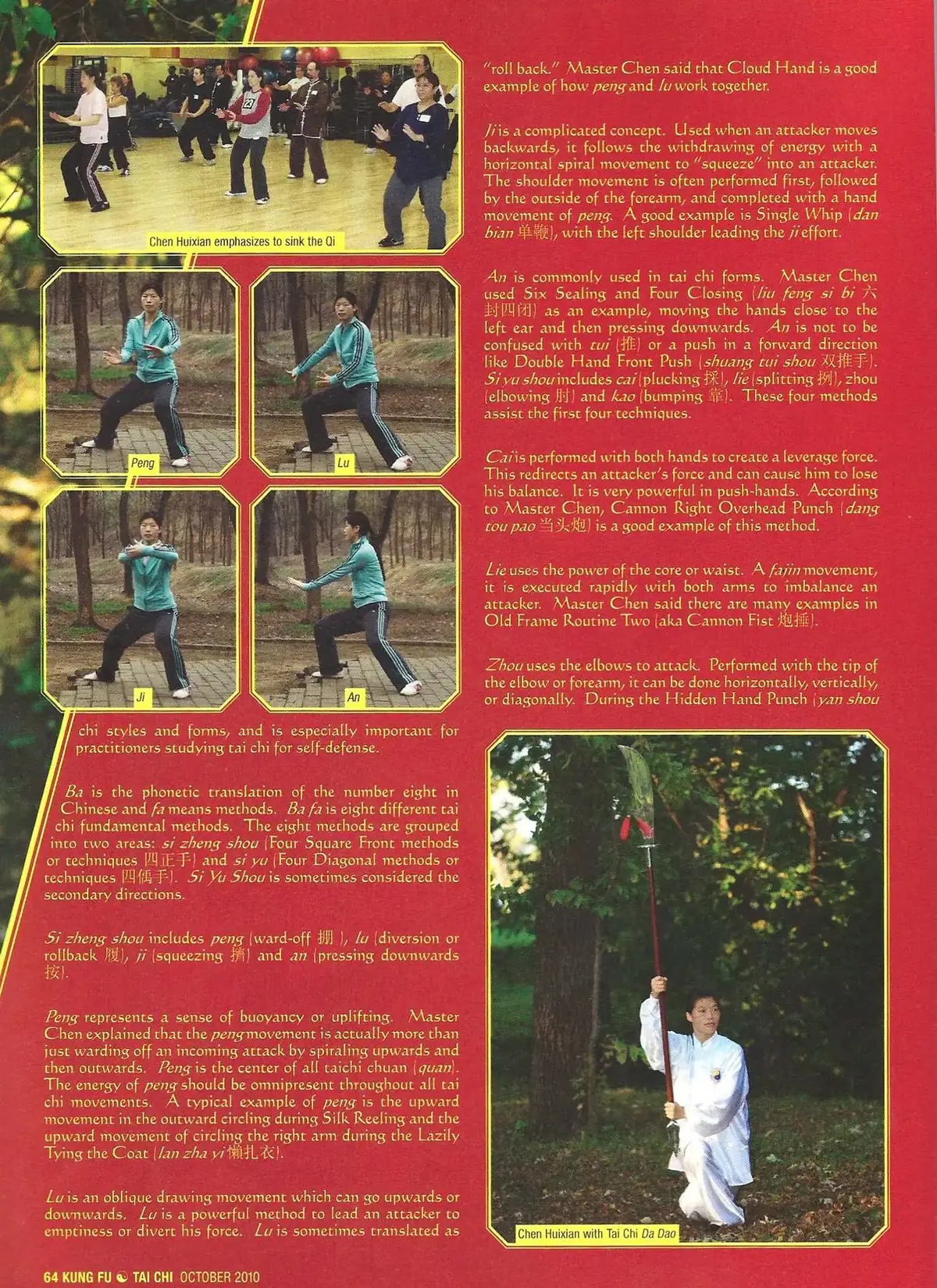
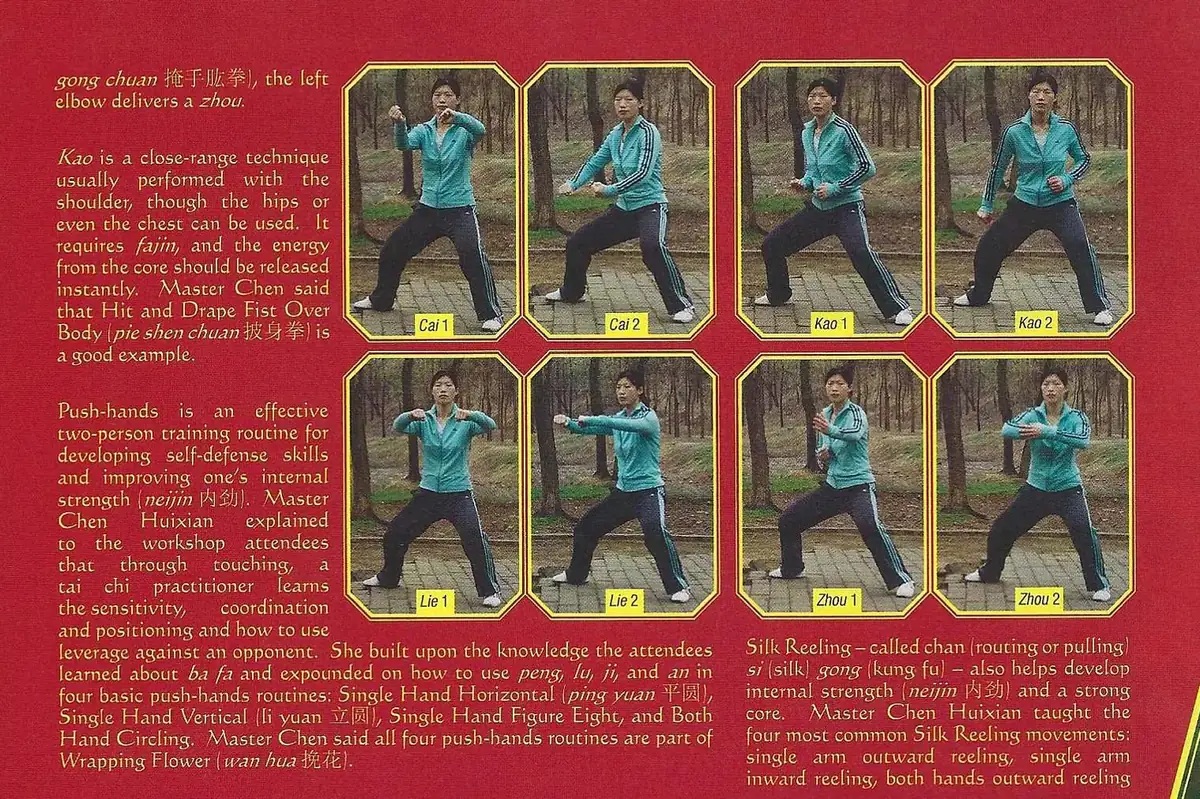
As a martial art, Chen Style Tai Chi focuses on developing both combatant skills as well as wellness factors. Taiji Ba Fa is the fundamental technique for all Tai Chi styles and forms. It is especially important for practitioners who prefer using Tai Chi as a martial art for self-defense purpose. Ba is the phonetic translation of the number eight in Chinese and Fa means methods. Ba Fa is eight different Tai Chi fundamental methods. The eight methods are grouped into two areas: Si Zheng Shou (aka Four Square Front methods or techniques 四正手) and Si Yu (aka Four Diagonal methods or techniques 四偊手). Si Yu Shou sometimes is considered the secondary directions. Master Chen explained in details how to execute each of the movements and also provided its martial art applications which captured the attention of the students’. Si Zheng Shou includes Peng (ward-off掤 ), Lu (diversion or rollback履), Ji (Squeezing 擠) and An (Pressing downwards 按). Peng represents a sense of buoyancy or uplifting. Master Chen explains that the Peng movement is actually more than just warding off an incoming attacking force by spiraling upwards and then outwards. Peng is the center of all Taichi Chuan (quan). The energy of Peng should be omnipresent throughout all Tai Chi movements. A typical example of Peng is the upward movement in the outward circling during Silk Reeling and the upward movement of circling the right arm during the Lazily Tying the Coat (Lan Zha Yi懶扎衣). Lu is an oblique drawing movement which can go upwards or downwards. Lu is a powerful method to lead an attacker to emptiness or divert his force. Lu is sometimes translated into “roll back”. Master Chen says that Cloud Hand is a good example of how Peng and Lu work together. Ji has a complicated concept. It is used when an attacker is going backwards. It follows the withdrawing of energy by an attacker with a horizontal spiral movement to “squeeze” into an attacker. Oftentimes, it is used with the shoulder movement first, outside of the forearm second and complete it with a hand movement of Peng. A good example is Single Whip (Dan Bian单鞭) with the left shoulder leading the Ji effort. An is commonly used in Tai Chi forms. Master Chen uses Six Sealing and Four Closing (Liu Feng Si Bi六封四闭) as an example which we move hands close to
left ear and then press downwards. An is not to be confused with Tui (推) or a push in a forward direction like Double Hand Front Push (Shuang Tui Shou 双推手).
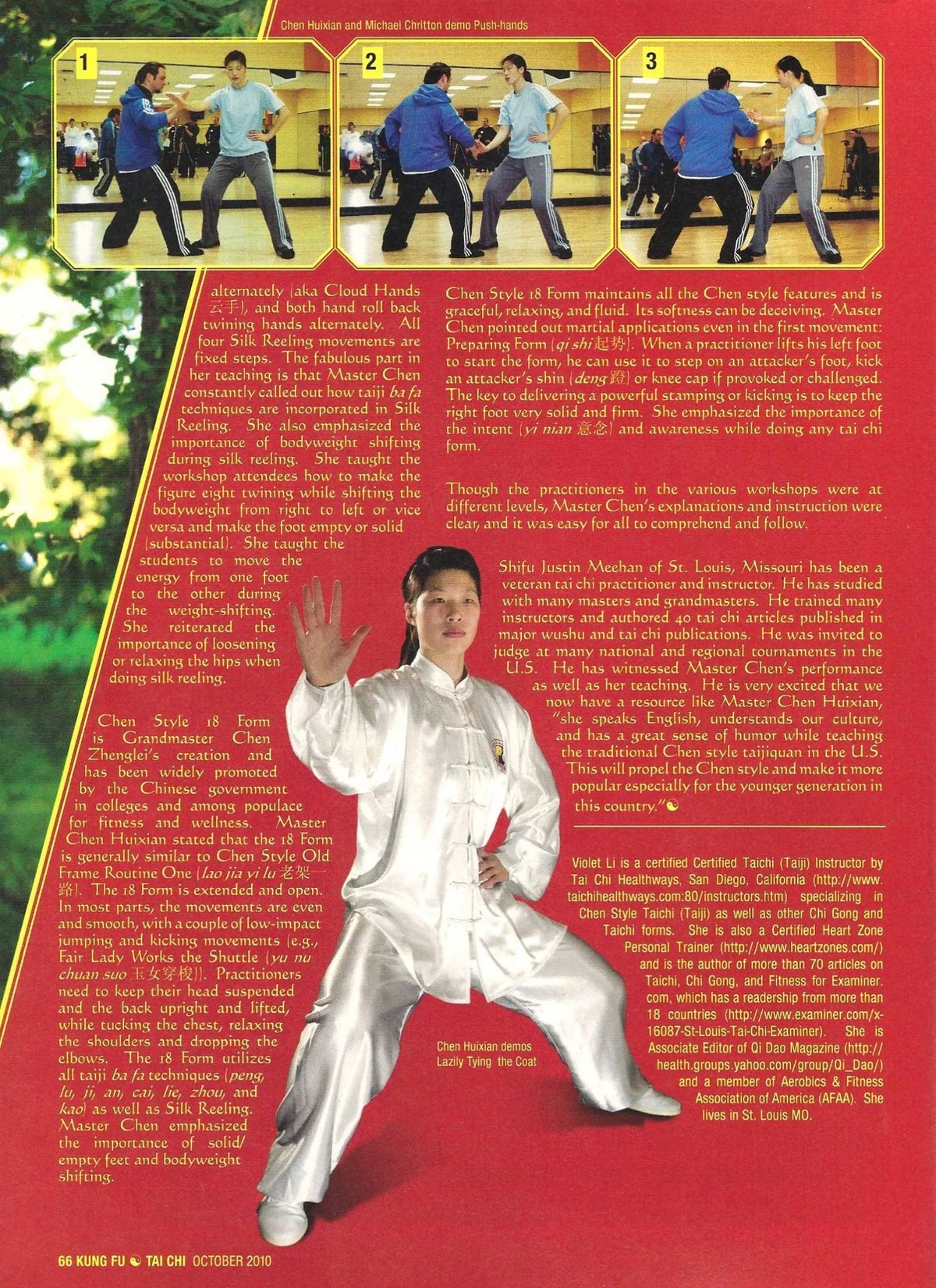
Si Yu Shou includes Cai (plucking採), Lie (splitting挒), Zhou (elbowing肘) and Kao (bumping靠). These four methods assist the first four techniques. Cai is performed with both hands to create a leverage force. It will redirect an attacker's force and can cause him to lose his balance. It is very powerful in Push Hands. Cannon Right Overhead Punch (Dang Tou Pao 当头炮) is a good example of this method according to Master Chen. Lie is uses the power of the core or waist. It is executed with both arms and a rapid movement to cause an attacker's imbalance. Master Chen says there are many examples in Old Frame Routine Two (aka Cannon Fist炮捶). It is a fajin movement. Zhou is using the elbows to attack. It can be done horizontally, vertically, and diagonally. It can be performed with the tip of the elbow or the forearm. During the Hidden Hand Punch (Yan Shou Gong Chuan 掩手肱拳), the left elbow delivers a Zhou. Kao is a close-range technique. Mostly it is performed with a shoulder but it can also be executed with the hips or even the chest. It requires fajin and the energy from the core should be released momentarily. Master Chen says that Hit and Drape Fist Over Body (Pie Shen Chuan披身拳) is a good example. Push Hands is a two-person training routine which is extremely useful for developing self-defense skills. Push Hands training can improve one's internal strength (or neijin内 劲). Master Chen Huixian explained to the workshop attendees that through the skin touching with another person, a Tai Chi practitioner learns the sensitivity, coordination and positioning and how to use leverage against an opponent. She built upon the knowledge the attendees learned about Ba Fa and expounded how to use Peng, Lu, Ji, and An in four basic Push Hands routines: Single Hand Horizontal (Ping Yuan平圆), Single Hand Vertical (Li Yuan 立圆), Single Hand Figure Eight, and Both Hand Circling. Master Chen said all four Push Hands routines are part of Wrapping Flower (Wan Hua挽 花). Silk Reeling is also called Chan (routing or pulling) Si (silk) Gong (kung fu). It also helps a Tai Chi practitioner develop internal strength (or neijin 内劲) and a strong core. Master Chen Huixian taught the four most common Silk Reeling movements: single arm outward reeling, single arm inward reeling, both hands outward reeling alternately (aka Cloud Hands云手), and both hand roll back twining hands alternately. All four Silk Reeling movements are fixed steps. The fabulous part in her teaching is that Master Chen constantly called out how Taiji Ba Fa techniques are incorporated in Silk Reeling. She also emphasized the importance of body weight shifting during silk reeling. She taught
the workshop attendees how to make the figure eight twining while shifting the body weight from right to left or vice versa and make the foot empty or solid (substantial). She taught the students to move the energy from one foot to the other during the weight shifting. She reiterated the importance of loosening or relaxing the hips when doing silk reeling. Chen Style 18 Form is Grandmaster Chen Zhenglei's creation which was widely promoted by the Chinese government in colleges and among populace for fitness and wellness. Master Chen Huixian stated that the 18 Form is generally similar to Chen Style Old Frame Routine One. The 18 Form is extended and open. In most parts, the movements are even and smooth and with a couple of low impact jumping and kicking movements, e.g. Fair Lady Works the Shuttle (Yu Nu Chuan Suo 玉女穿梭). Practitioners need to keep their head suspended and the back upright and lifted. It is very important to tuck the chest, relax the shoulders and drop the elbows. The 18 Form utilizes all Taiji Ba Fa techniques (Peng, Lu, Ji, An, Cai, Lie, Zhou, and Kao) as well as Silk Reeling. Master Chen emphasized the importance of solid/empty feet and body weight shifting. Chen Style 18 Form is very graceful, relaxing, and fluid. However, it still keeps all the Chen Style features. Its softness can be deceiving. Master Chen pointed out the first movement Preparing Form (Qi Shi 起势) actually has a few martial art applications. When a practitioner lifts his left foot to start the form, he can use it to step on an attacker's foot, kick an attacker's shin (deng 蹬) or knee cap if provoked or challenged. The key is to deliver a powerful stamping or kicking is to keep the right foot very solid and firm. She emphasized the importance of the intent (Yi Nian意念) and awareness while doing any Tai Chi form. Even though there were different levels of practitioners in the various workshops, her explanation and instruction were very clear. It was easy for them to comprehend and follow. Shifu Justin Meehan (http://www.jjustinmeehan.com/MartialArts.html) of St. Louis, Missouri has been a veteran Tai Chi practitioner and instructor. He has studied with many masters and grandmasters. He also trained many instructors and authored 40 Tai Chi articles published in major Wushu and Tai Chi magazines. He was invited to be a judge at many national and regional tournaments in the U.S. He has witnessed Master Chen's performance as well as her teaching. He is very excited that we now have a resource like Master Chen Huixian, “she speaks English, understands our culture, and has a great sense of humor while teaching the Traditional Chen Style Taijiquan in the U.S. This will propel the Chen Style and make it more popular especially for the younger generation in this country.”